The problem
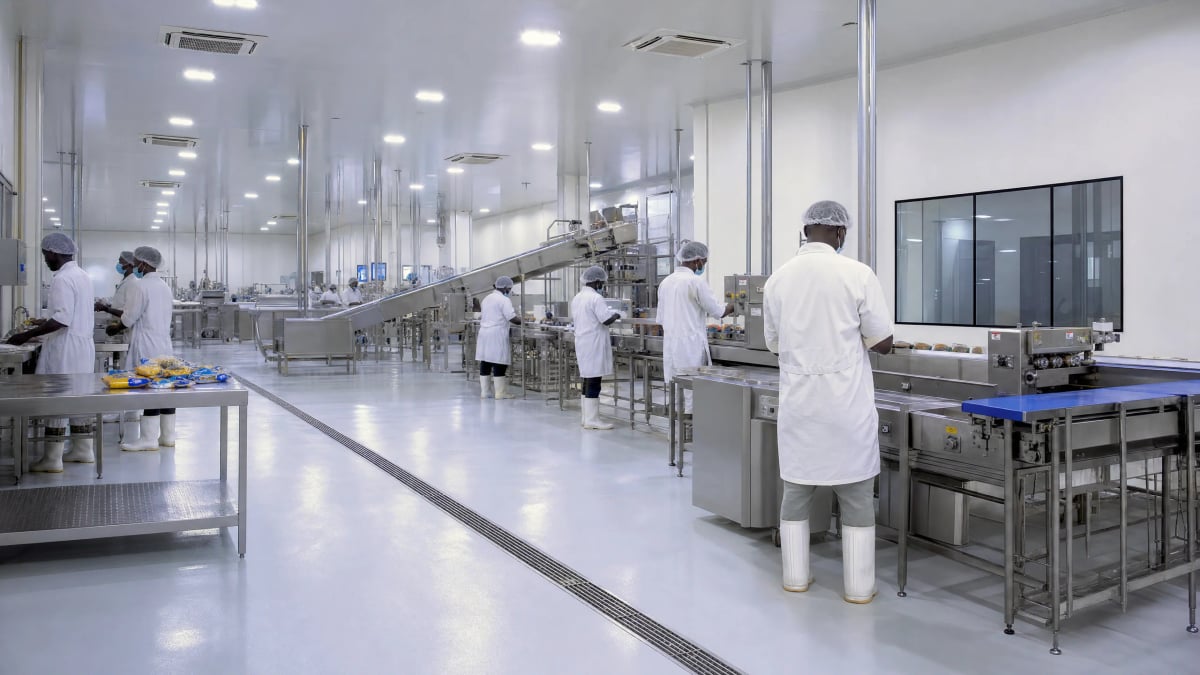
Food production operations under HACCP audit require flooring that satisfies FDA food-contact compatibility, integrated coved bases (no joints for bacteria harborage), and antimicrobial spec across daily wash-down cycles.
Our approach
Epoxy Flooring Ghana installs FDA-compliant hygienic epoxy systems with seamless coved bases, antimicrobial additives, and full HACCP-aligned QC documentation for the food production halls Ghana's premier manufacturers operate.
Epoxy Flooring Ghana installs FDA-compliant hygienic epoxy systems with seamless coved bases, antimicrobial additives, and full HACCP-aligned QC documentation for the food production halls Ghana's premier manufacturers operate.
The Challenge
Food production facilities operate under a compliance regime that tolerates no ambiguity. Ghana’s Food and Drugs Authority mandates hygienic surfaces that are seamless, chemically resistant, and auditable — a standard that conventional concrete and ceramic tile installations cannot meet once production volumes scale and cleaning cycles intensify. Cracks harbour pathogens. Grout lines accumulate biofilm. A floor that fails an FDA site audit does not merely cost a remediation budget; it halts production and jeopardises export certifications built over years.
The industrial food sector along the Spintex corridor and within Tema’s processing zones is expanding at a pace that demands specification-grade answers. Cold rooms, wet processing halls, baking production lines, and poultry processing facilities each impose distinct chemical and thermal loads on floor surfaces — from caustic clean-in-place solutions to the thermal shock of cold-water washdowns against warm production floors. A single specification must account for all of these simultaneously, with full HACCP-aligned documentation available for every product used.
For facility managers and quality assurance leads commissioning a new production hall or refurbishing an existing one, the floor is not a finishing item — it is a critical control point.
The Epoxy Flooring Ghana Solution
Epoxy Flooring Ghana has delivered hygienic flooring systems to Ghana’s food manufacturing sector since 1981 — 45 years of practice that includes early HACCP documentation protocols, antimicrobial additive integration, and coved base detailing long before these were standard procurement requirements. Our methodology begins with a full substrate assessment and environmental brief, mapping cleaning chemical concentrations, drainage patterns, forklift routing, and thermal cycling before a single system is specified.
Our food-plant systems are installed as fully seamless membranes with coved skirting bases — eliminating the floor-to-wall junction that conventional construction leaves as an uncleanable harbour point. Antimicrobial silver-ion additives are compounded into the broadcast layer where the client’s QA protocol requires bacteriostatic surface properties. The completed system is issued with full material data sheets, installation records, and a QC documentation package structured for FDA and HACCP audit submission.
The result is a surface a production manager can swab, a QA officer can document, and a client’s export compliance team can present to international buyers without qualification.
Material + System Specification
- Substrate preparation: Diamond-head mechanical scarification to CSP 3–4, with moisture vapour emission testing prior to priming
- Base coat: High-build solvent-free epoxy primer, formulated for wet-area substrate conditions common to Ghanaian industrial builds
- Body system: Multi-layer seamless epoxy screed (3–6 mm build-up) with non-slip quartz broadcast, rated for heavy forklift and pallet-jack traffic
- Antimicrobial layer: Silver-ion bacteriostatic additive integrated into topcoat where HACCP protocol specifies active surface protection
- Coved skirting base: 100 mm seamless epoxy cove, eliminating floor-to-wall junctions per FDA hygienic construction guidance
- QC documentation: Full batch traceability, installation log, and HACCP-aligned compliance record issued on project handover
Typical Project Profile
A representative engagement covers 800–4,000 square metres of food production hall, prep area, cold-room anteroom, and corridor — typically completed in 7–14 working days depending on substrate remediation requirements. Sectors served include beverage bottling, grain and cereal processing, poultry and meat handling, bakery production, and pharmaceutical-adjacent nutraceutical manufacturing. Projects are scheduled around production shutdowns wherever possible, with phased installation available for facilities that cannot sustain a full-floor shutdown.
Outcomes
- FDA audit-ready surface — seamless, swabbable, fully documented for regulatory inspection from day one of production
- Biofilm elimination — coved base and antimicrobial topcoat remove the two primary pathogen-harbour points that tile and bare concrete cannot address
- Chemical and thermal resilience — the installed system withstands caustic CIP concentrations and cold-water thermal shock without delamination or surface breach
- Traffic-rated durability — non-slip quartz broadcast sustains heavy forklift routing without surface degradation across extended production cycles
- Recognised specification standard — Epoxy Flooring Ghana holds the T3GA Gold Award in Specialist Epoxy Flooring (Cert ID: T3G-2002-793668), affirming the specification rigour food manufacturers commission us to deliver