The problem
Existing concrete substrates frequently fail moisture, levelness, or surface-profile specification — and tile-grade or coating-grade installations on inadequate substrate guarantee premature failure within 12-18 months.
Our approach
Epoxy Flooring Ghana provides specification-grade substrate engineering — ASTM F2170 moisture verification, ICRI CSP profile preparation, self-levelling correction, and structural concrete repair — as standalone commission or preparatory phase.
Epoxy Flooring Ghana provides specification-grade substrate engineering — ASTM F2170 moisture verification, ICRI CSP profile preparation, self-levelling correction, and structural concrete repair — as standalone commission or preparatory phase.
The Challenge
Every high-performance floor system is only as durable as the substrate beneath it. Concrete that carries concealed moisture, surface laitance, existing coating residue, or profile inconsistency will defeat even the most sophisticated resin installation within months — blistering, delaminating, or cracking under service load. This is not a materials failure; it is a preparation failure. Facilities that cannot afford operational disruption — pharmaceutical plants, Tier-1 bank headquarters, logistics hubs, food and beverage processing plants — have zero tolerance for that outcome.
Ghana’s climate compounds the challenge. Relative humidity, ground moisture migration through slab, and diurnal temperature variation accelerate concrete outgassing at rates that exceed what unaided visual inspection can detect. Without calibrated in-situ verification, a substrate that appears sound may carry internal moisture levels that will sabotage adhesion, regardless of how technically advanced the resin system applied over it may be.
Structural concrete defects present a separate category of risk. Delaminated sections, shrinkage cracks, honeycombing, and level variance accumulate over the service life of a facility. When a floor specification calls for a high-build epoxy or a decorative metallic system, these defects translate directly into finish irregularity, structural weakness, and premature system failure. Substrate engineering is not a preparatory courtesy — it is a load-bearing discipline in its own right.
The Epoxy Flooring Ghana Solution
Established in 1981 — 45 years of performance-engineered floor practice — Epoxy Flooring Ghana commissions substrate engineering as a standalone specialist engagement or as the preparatory phase of a full system installation. The discipline is structured around three sequential activities: scientific moisture verification, mechanical profile preparation, and structural repair with cementitious or epoxy-based correction compounds.
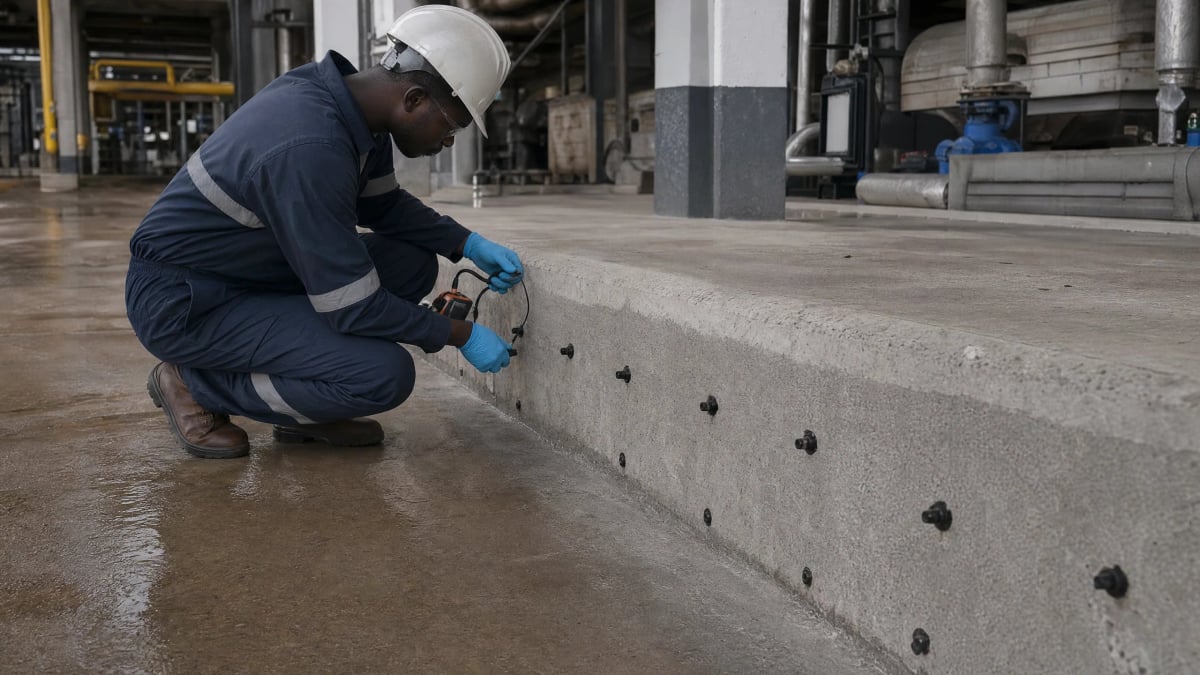
Moisture assessment follows ASTM F2170 protocols using calibrated in-situ relative humidity probes, not surface-only readings. Profile preparation is executed to ICRI Concrete Surface Profile standards, with the target CSP grade selected in direct reference to the adhesion requirements of the intended resin system. Where the slab presents level variance exceeding installation tolerance, self-levelling underlayments rated to 20–40 MPa compressive strength are applied to achieve a planar, specification-correct surface before any coating work begins.
Structural concrete repair uses polymer-modified cementitious mortars for crack-filling, section rebuilding, and surface consolidation, or two-component epoxy repair systems where chemical resistance and bond strength criteria are non-negotiable. Every phase is documented — probe readings logged, CSP profiles recorded, repair compound batch numbers noted — producing a substrate certification dossier that becomes part of the project record and supports any warranty terms on the overlying system.
Material + System Specification
- Moisture verification: ASTM F2170 in-situ relative humidity probes; readings logged to sub-floor depth schedule
- Surface preparation: Shot blasting, diamond grinding, or scarification to ICRI CSP 3–6 profile as system requires
- Self-levelling correction: 20–40 MPa compressive-strength underlayment compounds; application tolerance ±2 mm over 3 m
- Structural repair mortars: Polymer-modified cementitious compounds; tensile bond strength ≥1.5 MPa to parent concrete
- Epoxy injection and fill: Two-component epoxy repair systems for active cracks and delaminated sections demanding chemical-resistant consolidation
- Documentation package: Substrate certification dossier with probe logs, CSP records, and repair compound traceability
Typical Project Profile
Substrate engineering engagements range from 300 m² single-zone assessments in pharmaceutical clean-room suites to 5,000 m² full-facility preparation campaigns across logistics and manufacturing plants. Timelines are calibrated to the facility’s operational schedule — night-shift preparation programmes are available for occupied Tier-1 commercial and financial-institution environments. Sectors served include pharmaceutical manufacturing, food-grade processing, Tier-1 financial institution headquarters, warehouse and cold-chain logistics facilities, and multinational regional office fit-outs.
Outcomes
- Substrate moisture brought within resin system adhesion threshold before any coating is applied, eliminating blister risk
- Planar, specification-correct surface profile confirmed against ICRI standards and documented for project record
- Structural defects resolved to parent-concrete equivalence, preventing finish irregularity under live service load
- Documented substrate certification dossier supporting full system warranty and client facility records
- Significant reduction in premature system failure, extending operational floor life across the facility’s planned asset cycle