The problem
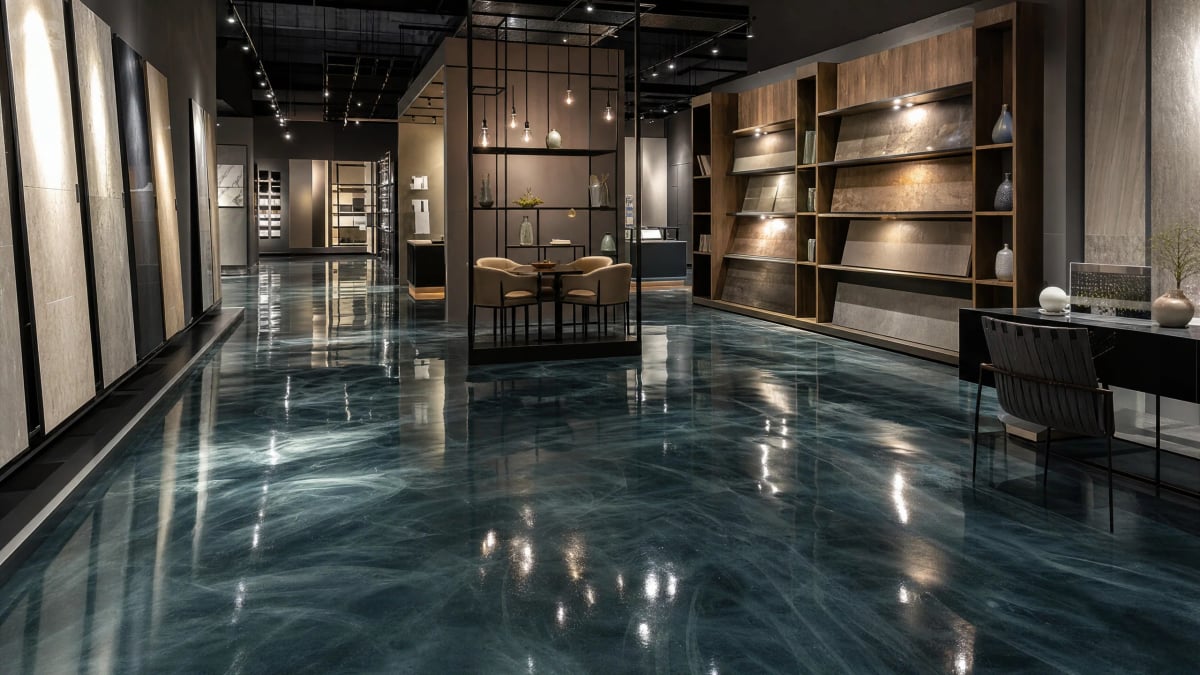
Corporate showrooms and retail flagships face the dual demand of high-impact visual register paired with sustained foot-traffic durability — decorative finishes that compromise on either dimension fail within their first commercial cycle.
Our approach
Epoxy Flooring Ghana delivers decorative metallic epoxy systems with high-pigment statement finishes paired with abrasion-rated topcoat for corporate showrooms, retail flagships, and automotive showrooms where the floor is part of the brand.
Epoxy Flooring Ghana delivers decorative metallic epoxy systems with high-pigment statement finishes paired with abrasion-rated topcoat for corporate showrooms, retail flagships, and automotive showrooms where the floor is part of the brand.
The Challenge
In spaces where the floor is the first impression — corporate showrooms, automotive flagship suites, retail environments at international gateway precincts — surface specification is not a secondary consideration. It is a primary brand instrument. A floor that scuffs under foot traffic, yellows under UV wash, or reads as generic polished concrete signals institutional indifference to the very clients an organisation has invested millions to impress.
The compounding difficulty is specification complexity. Decorative finishes that achieve genuine visual depth require high-pigment systems layered with precision — not single-pour aesthetics that photograph well but degrade within eighteen months. Corporate facilities managers and project architects working in Airport City, the Ridge diplomatic corridor, and premium Tema Coastline developments require a system that performs as a durable substrate and delivers a finish that sustains the brand narrative across a ten-year lifecycle.
Standard terrazzo and large-format tile alternatives introduce grout-joint maintenance liability and seismic-sensitivity risk that performance-critical environments cannot absorb. A seamless, specification-grade decorative system is the only technically defensible choice.
The Epoxy Flooring Ghana Solution
Established in 1981, Epoxy Flooring Ghana has spent 45 years engineering decorative metallic epoxy systems that resolve the fundamental tension between aesthetic ambition and structural durability. The studio’s approach begins with substrate forensics — moisture vapour transmission testing, tensile pull testing, and crack-mapping — before any material is selected. The decorative layer is built on a foundation that is already performance-certified, not cosmetically applied over a compromised base.
The metallic pigment systems deployed are sourced at specification-grade density, delivering the liquid-marble, deep-ocean, and molten-copper visual registers demanded by flagship interiors. Pigment distribution is hand-manipulated during the open window of each pour, producing finish patterns that are non-repeating and site-unique — a critical distinction from mass-market poured floors where pattern uniformity announces the product’s commodity origin.
The final stage applies an abrasion-rated aliphatic polyurethane topcoat engineered for UV stability and chemical resistance. This topcoat sustains gloss retention across high-footfall corporate and retail environments without the yellowing degradation that afflicts amine-cured epoxy systems. The result holds its specification intent across a ten-year maintenance cycle.
Material + System Specification
- Substrate preparation: Diamond-head mechanical grinding to CSP 3–4, moisture vapour testing to ASTM F2170, crack injection and levelling compound application where indicated
- Primer coat: 100% solids epoxy penetrating primer, applied at 150–200 microns DFT for chemical bonding to prepared substrate
- Metallic base layer: High-density metallic pigment epoxy broadcast at 400–600 microns DFT; hand-manipulated finish — site-unique pattern, non-repeating
- Broadcast sealer: Clear seal coat to lock pigment dispersion and create visual depth plane prior to topcoat application
- Topcoat: Aliphatic polyurethane, UV-stable, abrasion-rated, 120–150 microns DFT; pencil hardness rating 2H minimum; anti-slip additive available at client specification
- Total system DFT: 900–1,100 microns; fully seamless, zero grout-joint liability
Typical Project Profile
A standard decorative metallic showroom installation ranges from 300 m² to 2,000 m² depending on facility tier and phase configuration. Projects are structured in three-to-five-day active installation windows following substrate preparation, with a 72-hour cure-to-traffic protocol before soft opening. Sectors served include automotive flagship showrooms, corporate headquarters reception halls, premium retail flagships, and airport-precinct branded environments. The system is fully compatible with underfloor heating substrates and integrates cleanly with glazed curtain-wall lobby specifications.
Outcomes
- Sustained brand legibility: Metallic finish sustains visual specification across a ten-year lifecycle without polish-refreshment programmes
- Zero grout-joint liability: Seamless system eliminates the maintenance and aesthetic degradation associated with tile or terrazzo alternatives
- UV-stable gloss retention: Aliphatic topcoat resists yellowing under sustained ambient and direct UV exposure — critical for curtain-wall lobby environments
- Slip-resistance compliance: Anti-slip additive option meets institutional occupational health specifications without compromising aesthetic register
- Specification pedigree: Recognised at the Top 3 Ghana Awards — Gold, Specialist Epoxy Flooring (Cert ID: T3G-2002-793668) — a standard the studio has held since early institutional practice