The problem
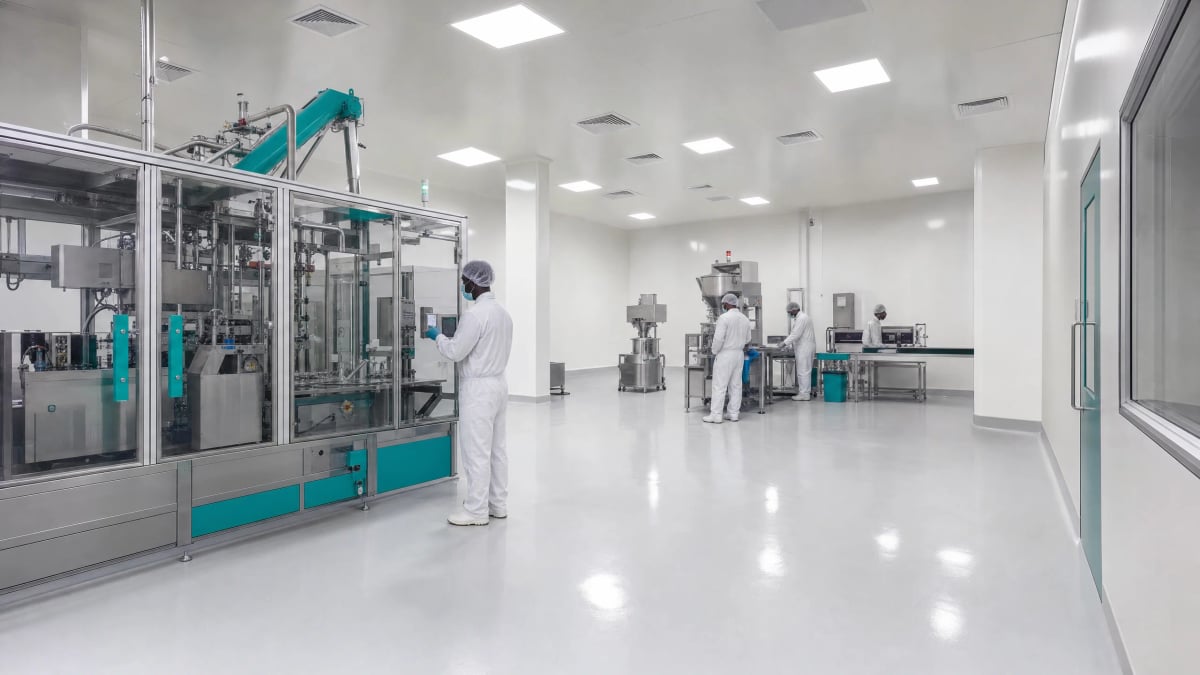
Pharmaceutical manufacturing under ISO 14644 cleanroom classification requires epoxy systems with documented particle generation rates, controlled-environment cure cycles, and ESD compliance where validated equipment demands it.
Our approach
Epoxy Flooring Ghana delivers ISO 14644 Class 5/6/7/8 compliant epoxy systems with multi-coat application discipline, particle-free cure protocols, and IEC 61340-5-1 ESD integration where the cleanroom envelope requires.
Epoxy Flooring Ghana delivers ISO 14644 Class 5/6/7/8 compliant epoxy systems with multi-coat application discipline, particle-free cure protocols, and IEC 61340-5-1 ESD integration where the cleanroom envelope requires.
The Challenge
Pharmaceutical manufacturing, biotechnology processing, and precision medical device assembly share a single, non-negotiable requirement: the floor beneath every operation must not become a source of contamination. In ISO 14644-classified environments, particle shedding from a degrading floor surface is not a maintenance issue — it is a regulatory crisis. A floor that dusts, cracks, or harbours micro-porosity compromises cleanroom classification and can halt production lines valued at hundreds of thousands of cedis per shift.
Ghana’s growing pharmaceutical and life-sciences sector is commissioning cleanroom suites to international GMP standards, and the flooring envelope is among the most scrutinised elements during regulatory audit. Inspectors from FDA-Ghana, WHO pre-qualification teams, and multinational parent companies assess floor continuity, cove detailing, chemical resistance, and ESD performance as primary compliance indicators — not secondary finishes.
The compounding difficulty is Ghana’s tropical construction context: high ambient humidity, aggressive concrete substrate carbonation, and aggressive solvent exposure from cleaning protocols. A floor system that passes specification on paper but fails cure discipline under site conditions delivers neither compliance nor longevity. The consequences — facility downgrading, batch recalls, regulatory hold — are institutional, not cosmetic.
The Epoxy Flooring Ghana Solution
Epoxy Flooring Ghana has delivered cleanroom-grade floor systems since 1981, accumulating 45 years of practice across pharmaceutical, biotechnology, and medical-grade facilities throughout Ghana. Our approach begins before the first coat is applied: substrate assessment, moisture vapour transmission testing, and concrete surface profile verification are conducted to ICRI technical guidelines. No system is specified until the substrate can sustain it.
Our ISO 14644 Class 5 through Class 8 compliant floor systems employ a multi-coat application discipline that includes a penetrating primer, build coats of 100% solids epoxy, and a topcoat engineered for zero particle emission under standard cleanroom traffic loads. Where IEC 61340-5-1 ESD performance is required — electrostatic-sensitive manufacturing or advanced electronics assembly within a cleanroom envelope — conductive or static-dissipative layers are integrated within the system stack, with point-to-point resistance verified by calibrated instrumentation prior to handover.
Particle-free cure protocols are observed throughout: controlled application sequencing, restricted site access during cure windows, and temperature-humidity logging ensure that the system achieves specification-grade performance rather than approximating it.
Material + System Specification
- Base system: 100% solids, zero-VOC epoxy formulation; DFT 2 mm–6 mm depending on classification tier and traffic loading
- ISO 14644 compliance: Class 5, 6, 7, and 8 floor envelope configurations available; continuous coved skirting detail at 100 mm minimum for full sanitary seal
- ESD integration: IEC 61340-5-1 static-dissipative or conductive layer; point-to-point resistance range 10⁵–10⁸ Ω (SD) or 10⁴–10⁶ Ω (conductive); copper earthing grid to BS 7671
- Chemical resistance: Resistance to isopropanol (IPA), hydrogen peroxide, sodium hypochlorite, and common pharmaceutical cleaning agents; tested per ASTM C267
- Surface profile: Seamless, non-porous, micro-polish or matte-satin finish; Ra value selectable to facility protocol
- Substrate prep: Diamond-grind profile to ICRI CSP 3–5; moisture vapour emission rate verification to ASTM F1869 prior to prime coat
Typical Project Profile
A representative cleanroom flooring commission engages Epoxy Flooring Ghana at pre-fit-out stage, typically spanning 200 m² to 2,000 m² of classified floor area across multiple ISO classification zones. Pharmaceutical manufacturing facilities in Tema Industrial, biotech processing suites in Accra, and medical device assembly operations across the greater Accra region form the core of this portfolio. Programme durations range from 5 to 18 working days depending on zonal complexity, cure scheduling, and ESD verification requirements.
Outcomes
- Regulatory-grade cleanroom floor certification supporting FDA-Ghana, WHO GMP, and multinational parent-company audit requirements
- Zero particle-emission performance maintained under standard pharmaceutical cleaning and traffic protocols
- ESD compliance verified by calibrated instrumentation at project handover, with documentation package for facility qualification dossier
- Seamless coved skirting detail eliminating micro-harbourage zones identified in standard regulatory inspection checklists
- 45 years of cleanroom and industrial floor practice — recognised under Top 3 Ghana Awards (Specialist Epoxy Flooring, T3GA Gold, Cert ID: T3G-2002-793668)