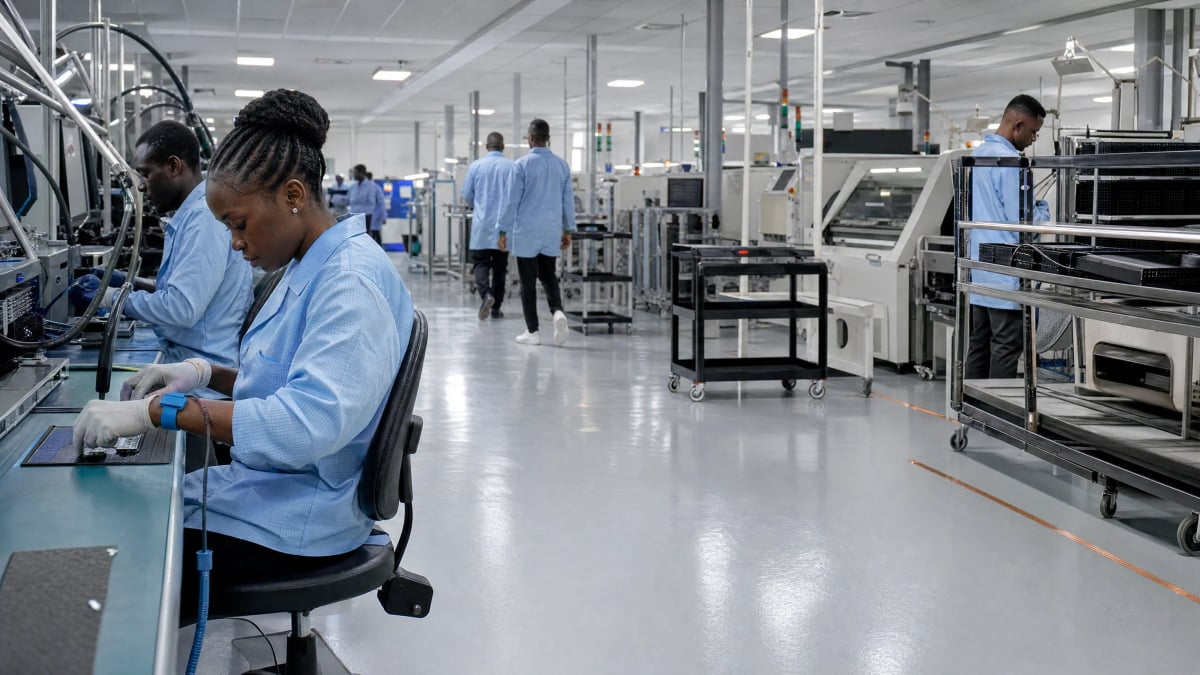
The problem
Electronics manufacturing, semiconductor handling, and pharmaceutical-cleanroom-adjacent environments require ESD-controlled flooring with documented IEC 61340-5-1 compliance across 10⁶-10⁹ Ω surface resistance.
Our approach
Epoxy Flooring Ghana delivers IEC 61340-5-1 compliant ESD systems with copper grounding network, conductive primer, and continuity-tested topcoat across electronics manufacturing assembly lines and ESD-classified cleanrooms.
Epoxy Flooring Ghana delivers IEC 61340-5-1 compliant ESD systems with copper grounding network, conductive primer, and continuity-tested topcoat across electronics manufacturing assembly lines and ESD-classified cleanrooms.
The Challenge
Electrostatic discharge is an invisible adversary. In electronics manufacturing environments — assembly lines producing printed circuit boards, semiconductor subassemblies, and precision sensors — a single uncontrolled static event can render an entire production batch defective. The failure may not surface until the finished product is in the field, compounding liability and recall exposure far beyond the cost of any floor.
Ghana’s expanding electronics manufacturing corridor and ESD-classified cleanroom facilities face a specification challenge that most flooring contractors are not equipped to answer. IEC 61340-5-1 compliance demands a grounded, measurable, and continuously testable flooring system — not a decorative coating applied over a concrete slab. The floor must function as an active component of the facility’s electrostatic control programme, maintaining surface resistance within defined limits across every square metre, every shift, every year.
Humidity variation, substrate contamination, and thermal cycling across Ghana’s coastal-industrial facility environments add further complexity. A flooring system that tests compliant at commissioning but drifts out of specification within eighteen months offers no real protection — and creates audit exposure for any manufacturer operating under ISO or customer-specific ESD control standards.
The Epoxy Flooring Ghana Solution
Since 1981, Epoxy Flooring Ghana has developed and refined ESD flooring systems for the most specification-critical facilities across Ghana’s industrial belt. Our approach begins with substrate forensics: concrete moisture assessment, surface pH testing, and contamination mapping before any material is committed. Where substrate conditions present risk to long-term system integrity, we remediate prior to priming — ensuring the grounding network bonds to a surface prepared to receive it.
The installed system comprises a copper tape grounding network laid to an engineered grid pattern, bonded to the facility’s central earth point, and encapsulated beneath a conductive primer formulated for continuous electrical continuity. The topcoat is selected for the specific resistance range demanded by the application — ESD-protective or ESD-conductive — and applied under controlled conditions to deliver a seamless, cleanable surface that meets both the electrical and hygiene demands of the environment.
Point-to-point resistance testing is conducted at commissioning across a defined grid of measurement locations, with results documented against IEC 61340-5-1 thresholds. Clients receive a full continuity test report, commissioning certificate, and maintenance specification — the institutional record that supports ongoing ESD audit compliance.
Material + System Specification
- Copper grounding network: Engineered grid layout, bonded to dedicated earth point, continuity-verified before encapsulation
- Conductive primer: Two-component epoxy formulation, surface resistance 10⁴–10⁶ Ω, applied at specification thickness
- ESD topcoat: Seamless epoxy or polyurethane topcoat, resistance range selected per IEC 61340-5-1 classification (ESD-protective: 10⁶–10⁹ Ω; ESD-conductive: 10⁴–10⁶ Ω)
- Substrate preparation: Diamond grinding, moisture barrier where required, surface pH correction prior to primer application
- Commissioning testing: Point-to-point and walking-body voltage tests per IEC 61340-5-1, documented grid results
- Documentation package: Continuity test report, commissioning certificate, maintenance and re-testing schedule
Typical Project Profile
A typical ESD flooring engagement covers 500–5,000 m² of production or cleanroom floor area, executed in phased sections to allow uninterrupted facility operations where scheduling constraints apply. Sectors served include electronics assembly, medical device manufacturing, pharmaceutical dispensing suites, and defence-adjacent precision manufacturing. Installation timelines for standard-scope projects run 2–4 weeks from substrate preparation through final commissioning test, with the documentation package delivered within five working days of project completion.
Outcomes
- IEC 61340-5-1 verified compliance across the full installed area, supported by a traceable commissioning test record
- Eliminated electrostatic discharge risk at the floor plane, reducing product defect rates attributable to static events
- Audit-ready documentation for ISO ESD control programme reviews and client-specific supplier qualification audits
- Durable, cleanable surface compatible with antistatic footwear, ESD trolley wheels, and routine facility cleaning protocols
- Long-term system integrity supported by a scheduled re-testing programme, keeping the floor within specification across its full service life