The problem
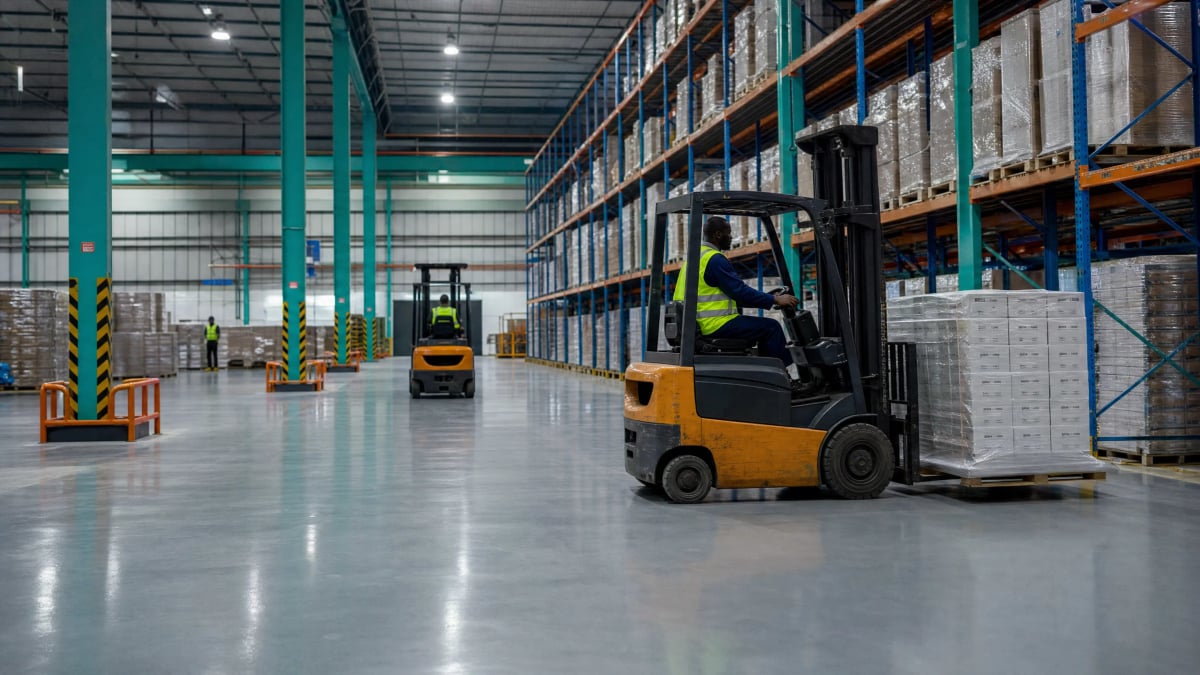
Port-adjacent logistics warehouses face sustained 10-tonne forklift traffic across rack-storage corridors plus chemical exposure from leaked product — conventional flooring fails within months without specification-grade engineering.
Our approach
Epoxy Flooring Ghana installs heavy-load epoxy systems with polyurethane topcoat over FF50+ self-levelling substrate — engineered for 10-tonne forklift point loads, hydrocarbon resistance, and 10+ year service life under continuous logistics operations.
Epoxy Flooring Ghana installs heavy-load epoxy systems with polyurethane topcoat over FF50+ self-levelling substrate — engineered for 10-tonne forklift point loads, hydrocarbon resistance, and 10+ year service life under continuous logistics operations.
The Challenge
A logistics warehouse floor endures punishment that most building elements never encounter. Forklift traffic concentrated on narrow wheel contact patches imposes point loads exceeding 10 tonnes repeatedly across the same lanes, hour after hour, shift after shift. Beneath that mechanical stress, hydrocarbon contamination from fuel spillage, hydraulic fluid, and lubricants attacks unprotected concrete, creating progressive porosity that accelerates structural degradation and generates the fine particulate that contaminates sensitive cargo.
Facilities that run continuous cold-chain, bonded warehousing, or high-frequency distribution operations carry an additional constraint: there is no maintenance window long enough to resurface a failed floor conventionally. A debonding screed, a spalling joint, or a cracked slab does not pause logistics throughput — it forces it. The cost of unplanned downtime in a Tier-1 distribution facility routinely exceeds the cost of the floor itself, which means specification decisions made at project inception carry consequences measured in years of operational risk.
Ghana’s Tema port corridor and Airport City logistics cluster compound these pressures with a coastal humidity profile and ground-level thermal cycling that degrades ordinary polymer coatings within 18 to 24 months. A system engineered for European ambient conditions rarely survives its second year in Ghana’s equatorial humidity without delamination, blush failure, or intercoat adhesion loss. The floor specification must be designed for this climate from the substrate up.
The Epoxy Flooring Ghana Solution
Our heavy-load logistics system begins with the substrate, not the coating. Following mechanical diamond-grinding to ICRI CSP 3–5 profile and comprehensive crack and joint remediation, we install a self-levelling epoxy base at FF50+ floor flatness tolerance — a specification standard that governs forklift mast stability and pallet-racking plumb over the full warehouse bay. This substrate work is unglamorous, invisible once complete, and entirely responsible for the system’s long-term performance.
Over the prepared substrate, we apply a multi-layer high-build epoxy system formulated for hydrocarbon resistance and compressive strength adequate for 10-tonne point loads. The final finish layer is a polyurethane topcoat selected for abrasion resistance under pneumatic and polyurethane tyre traffic, UV stability in facilities with skylighting, and the chemical resistance profile appropriate to fuel, lubricant, and cleaning-agent exposure. Line marking, bay demarcation, and safety zoning are integrated into the topcoat schedule — not applied as a secondary afterthought.
Established in 1981, and recognised with a T3GA Gold Award in Specialist Epoxy Flooring (Cert ID: T3G-2002-793668), our practice carries 45 years of floor performance data across Ghana’s industrial and logistics sectors. That institutional depth informs every substrate assessment, every material selection, and every cure-schedule decision made on site.
Material + System Specification
- Substrate preparation: Diamond-grinding to ICRI CSP 3–5; crack injection and joint bridging with semi-rigid polyurea
- Base system: Self-levelling high-build epoxy at FF50+ floor flatness tolerance, minimum 3 mm build depth
- Mid-coat: Chemical-resistant epoxy broadcast layer, formulated for hydrocarbon and solvent exposure
- Topcoat: Aliphatic polyurethane, 200–300 µm DFT, UV-stable, abrasion-rated for continuous forklift traffic
- Load engineering: Compressive strength specification to exceed 10-tonne forklift point-load requirements
- Line marking: Integrated into topcoat schedule — bay demarcation, pedestrian corridors, hazard zones
Typical Project Profile
This solution is specified across bonded warehousing facilities, cold-chain distribution centres, bulk-cargo handling sheds, and port-adjacent logistics parks across the Greater Accra and Tema Industrial corridors. A standard project scope runs from 1,500 m² to 12,000 m², with phased installation sequencing developed in collaboration with the facilities management team to maintain operational continuity. Typical installation-to-full-service timeline is 5 to 9 working days depending on floor area and ambient cure conditions.
Outcomes
- Forklift point-load tolerance exceeding 10 tonnes, sustained across continuous multi-shift operations
- Hydrocarbon and chemical resistance to fuel, hydraulic fluid, solvent, and industrial cleaning agents
- FF50+ floor flatness maintained across the full warehouse bay for racking plumb and mast stability
- Service life of 10+ years under logistics-intensity use when maintained to specification
- Operational continuity through phased installation — no full-facility shutdown required