Le problème
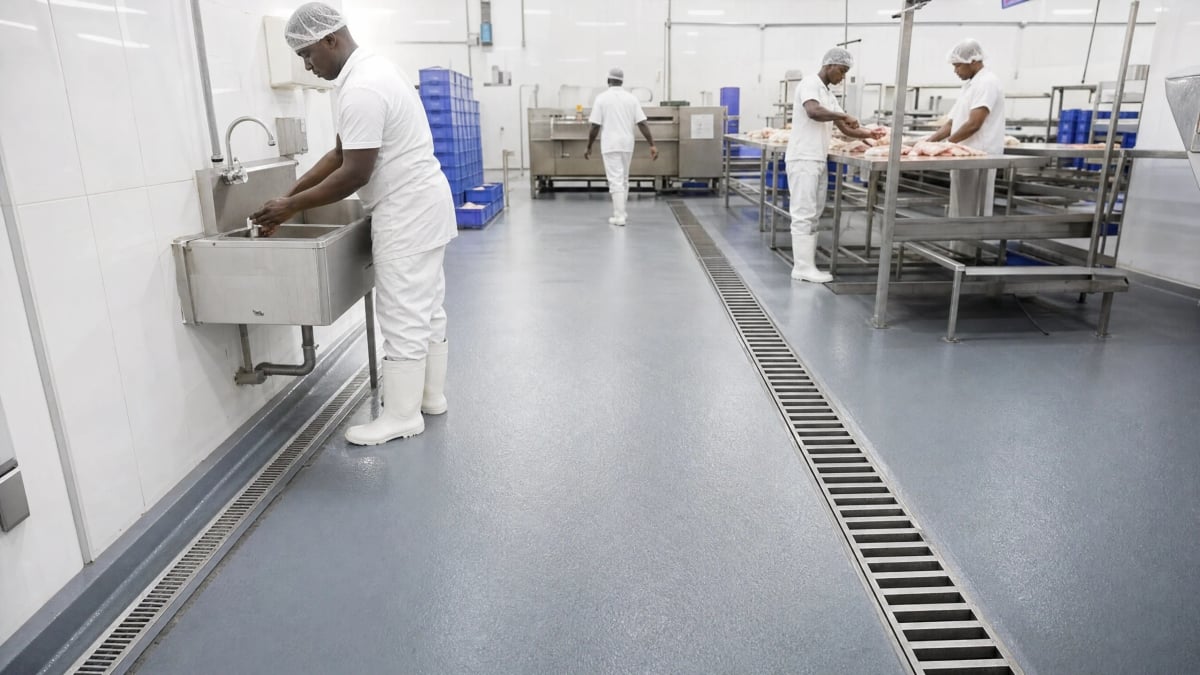
Commercial kitchens, hospital wet zones, food-processing washdown bays, and any wet-area environment require slip-rated flooring with documented R-rating compliance — generic flooring puts occupants at risk and operators in liability exposure.
Notre approche
Epoxy Flooring Ghana installs R10-R13 slip-rated epoxy systems with documented ASTM C1028 friction testing, integrated drainage falls, and antimicrobial finish for healthcare and food-processing wet-zone commissions.
Epoxy Flooring Ghana installs R10-R13 slip-rated epoxy systems with documented ASTM C1028 friction testing, integrated drainage falls, and antimicrobial finish for healthcare and food-processing wet-zone commissions.
The Challenge
Wet-zone environments — food-processing washdown bays, beverage-bottling wash halls, commercial kitchen floors, and clinical wash areas — impose failure conditions that standard floor finishes cannot withstand. Standing water, repeated thermal cycling, aggressive cleaning chemicals, and continuous foot traffic combine to degrade ordinary coatings within months, producing surfaces that are simultaneously hazardous and visually compromised. For facilities where a slip incident carries both human and institutional consequence, the floor specification is not an aesthetic decision. It is a liability management decision.
In Ghana’s food-processing and healthcare sectors, the stakes are compounded by climate. High humidity, elevated ambient temperatures, and the demands of year-round intensive occupancy accelerate coating breakdown faster than temperate-climate performance data would suggest. Facility managers frequently inherit floors that were specified for appearance rather than function — surfaces that look considered at commissioning but begin to fail within the first operational year.
The standard industry response — applying non-slip tape or surface grit after the fact — is neither specification-grade nor durable. It addresses symptom rather than system. What wet-zone floors require is an engineered solution specified from substrate preparation through to documented friction performance, integrated drainage geometry, and antimicrobial finish chemistry.
The Epoxy Flooring Ghana Solution
Established in 1981, Epoxy Flooring Ghana has spent 45 years refining wet-zone floor systems for facilities that operate without margin for error. Our anti-slip wet-zone methodology begins at substrate: diamond-preparation of the existing slab to CSP 3–4 profile, moisture assessment, and primer selection calibrated to ambient humidity. No coating system performs to specification on a substrate that has not been prepared to specification.
The primary system deploys broadcast-aggregate epoxy or polyurethane hybrid chemistry, yielding slip resistance rated R10 through R13 per DIN 51130 — with friction co-efficients independently tested to ASTM C1028. For healthcare commissions, antimicrobial additive packages are integrated at the topcoat stage, providing continuous inhibition against bacterial colonisation in clinical wash zones and sluice areas. Drainage falls — typically 1:80 to 1:60 gradient — are engineered into the screeded build-up prior to coating application, eliminating standing water at the source rather than managing it at the surface.
Colour and finish are resolved within the specification, not despite it. The same system that delivers R13 industrial slip resistance in a commercial kitchen can be tuned to a premium aesthetic — matte, satin, or custom-tinted — appropriate to a beverage-bottling washdown hall or a private hospital treatment corridor.
Material + System Specification
- Slip rating: R10 (light wet-zone) to R13 (heavy industrial wet-zone) per DIN 51130; friction testing documented to ASTM C1028
- System chemistry: Broadcast-aggregate epoxy or polyurethane-epoxy hybrid topcoat, selected to substrate and occupancy load
- Antimicrobial additive: Silver-ion or IPBC-based inhibitor integrated at topcoat for healthcare and food-preparation zones
- Drainage geometry: Screeded falls engineered at 1:80–1:60 gradient prior to coating application
- Chemical resistance: Tested resistance to quaternary ammonium disinfectants, bleach solutions, and food-grade oils
- Thickness build: 3 mm–6 mm total system depth depending on existing substrate condition and load classification
Typical Project Profile
A standard wet-zone commission engages our specialist team for substrate assessment, diamond preparation, screed fall installation, primer application, and two-coat finish system across areas ranging from 80 m² for a food-processing wash bay to 1,200 m² for a hospital ground-floor clinical corridor. Project timelines typically run 5 to 12 working days depending on area, drainage complexity, and cure scheduling. Sectors served include beverage-bottling and food-processing washdown halls, commercial kitchen environments, pharmaceutical and clinical wash zones, and cold-chain logistics wet areas.
Outcomes
- Documented ASTM C1028 friction performance delivered at practical commissioning — not inferred from data sheets alone
- Slip incident risk materially reduced across all standard wet-zone occupancy categories
- Antimicrobial topcoat chemistry active at installation and maintained through standard cleaning protocols
- Drainage falls integrated at screed level, eliminating standing water and extending coating service life
- Premium aesthetic finish retained across the full performance specification range